Why some queer Ohioans feel politically agnostic.
This story is published in partnership with the Queer News Network, a collaboration among 11 LGBTQ+ newsrooms to cover down ballot elections across 10 states. Read more about us here.
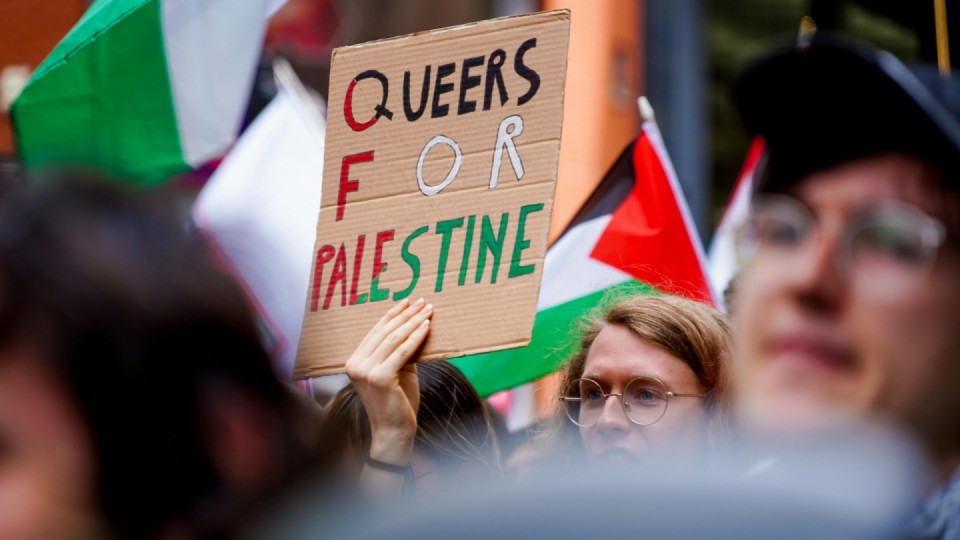
LGBTQ+ advocacy and progressive civil rights groups have been successful in engaging younger queer voters to cast their ballot in favor of Democrats this November. But interviews with a handful of young queer voters in Ohio illustrate how the party’s messaging around Israel and anti-trans attacks aren’t helping them win over everyone.
The split among progressive voters — particularly younger ones and Muslim-Americans upset with Democratic candidates’ stances on Israel — illustrates a larger problem nationally among Democrats unable to engage those who would otherwise vote with them on platform issues.
And for some queer Ohioans, that trend is true for them, as well.
“There's this frustrating assumption that queer people must support Democrats no matter what,” said Meghan Edwards, 25, a queer resident of Wayne County who voted for Claudia De La Cruz, the presidential candidate for the Party for Socialism and Liberation.
“Our rights are just sort of being held over our heads, you know, like you have to be okay with everything else,” Edwards said, adding the belief that Democrats have proposed queer progressives to “be OK” with the ongoing war in Gaza and issues related to climate change. “That's a really, really low bar.”
Luna Kasior, who is 38, nonbinary and lives in Toledo, is voting for Green Party candidate Jill Stein because of the Biden administration’s continued support of Israel, and they insist it is not a wasted vote.
“I have been very strongly advocating for voting third party anyways,” Kasior said. “The percentages get up there and more people feel confident about voting for a third party. Eventually we'll get there.”
Kasior is fearful of what a Trump administration could bring, but at the same time doesn’t believe the situation will improve under Harris: “I get misgendered on a regular basis,” Kasior said. “I really don't think it's going to escalate things to a point where they're going to be noticeably different than what they are right now.”
Lana, who requested to use only their first name, is a genderfluid pansexual Palestinian whose family is from the West Bank and lives in Cleveland. They are leaning towards voting for a third party while their mother is voting for Harris.
But it’s a decision made from fear, not hope, Lana said, referencing the recent remarks of former Trump lawyer Rudy Giuliani at Donald Trump’s rally in Madison Square Garden last weekend where he said without proof that Hamas teaches toddlers to kill Americans.
“It's just scary that Trump’s statements have been very openly pro-genocide, whereas Kamala has been sneaky about it, but also pro-genocide,” Lana said. “A lot of Democrats fail to remember that if this candidate is not sticking up for innocent children, then how is she going to faithfully stick up for other minorities?”
But divisions among queer people who do not vote Democrat isn’t a new trend. More voters within the community are seeing their issues as a larger blanket of problems, not just solely focused on “single-issue” politics, such as ensuring trans healthcare or abortion rights.
It’s a movement that LGBTQ+ communities have seen in the past, but it has accelerated in recent years. In Ohio, the local Log Cabin Republican group in Cleveland has had nearly 10% growth in their online group members in the past 6 months, mirroring the sizable support for Donald Trump within the LGBTQ+ community.
In a 2020 exit poll of voters on Election Night, The New York Times found that 27% of LGBTQ+ people had a favorable view of Trump. That number is lower than before, but only by 5 percentage points, according to a report from Data for Progress.
Despite the threat posed by Republicans, Kent resident Eva — who asked QNN not to use her last name for her safety - said that as a trans woman, she didn’t feel that Kamala Harris or other Democrats would keep her safe.
Incumbent U.S. Senator Sherrod Brown, a Democrat running against Republican Bernie Moreno, repeated the false claim in a fact check that transgender women are “transgender biological men” in a recent campaign ad, upsetting some trans residents that Brown continued to amplify anti-trans rhetoric.
“Kamala Harris, when asked to give her position on trans people in her own words, said that we should follow the law,” Eva said. “That gives me no hope as a transgender woman that she will support me.”